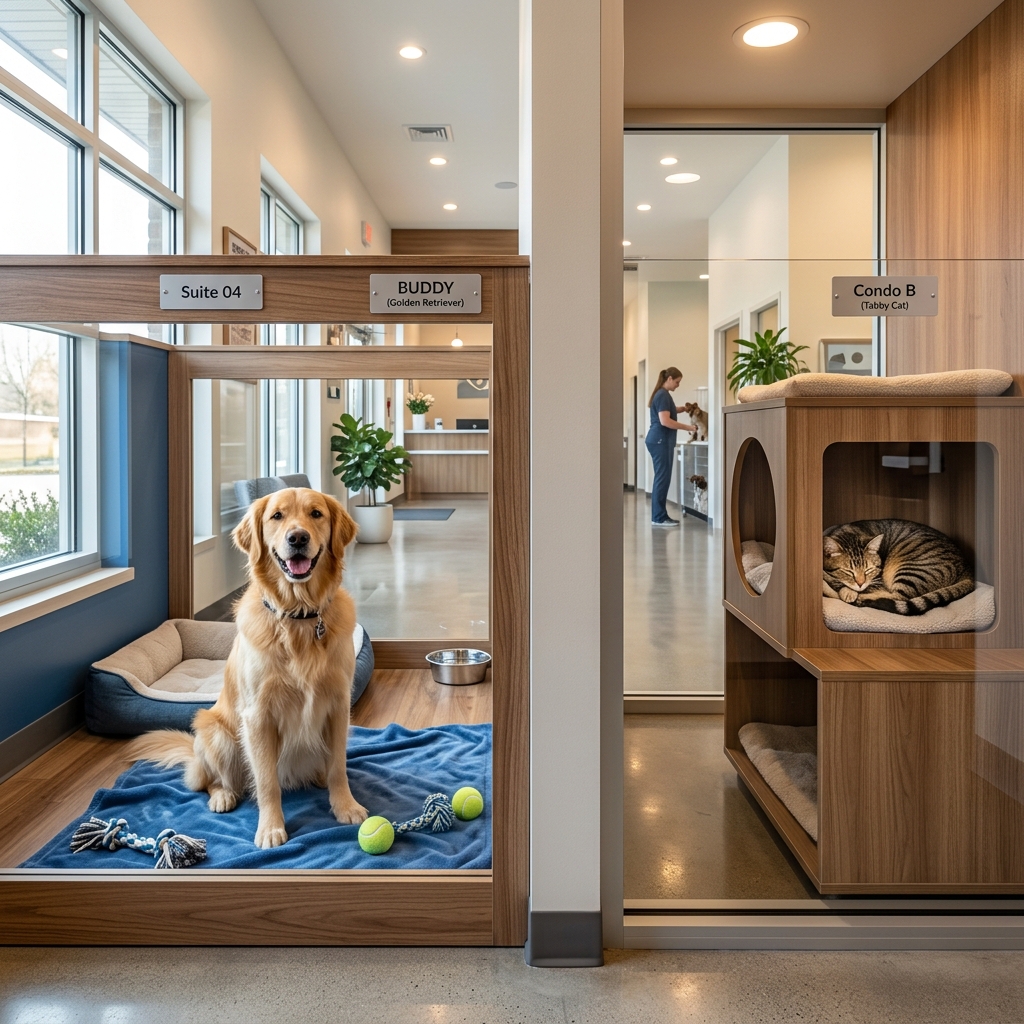
A glossy website and friendly photos aren't enough information. Here's exactly what to ask, what to check in person, and what should make you walk away.
Leaving your pet somewhere else, even for a couple of days, comes with a particular kind of worry. Will they eat? Will they be handled gently if they're anxious? Will anyone actually notice if something's wrong? A facility's Instagram photos won't answer any of that — but the right questions will.
This guide skips the generic "look for a clean facility" advice you've already read everywhere, and focuses on the specific questions and red flags that actually separate a well-run boarding facility from one that just looks the part.
Boarding, Pet Sitting, or Daycare?
Before comparing facilities, it's worth checking you're even looking at the right option.
Boarding facility: Best for trips of 2+ days, pets comfortable around other animals. In-home pet sitter: Best for anxious pets, pets needing routine in their own space. Daycare: Best for single workdays or short outings, not overnight.
If your pet gets visibly stressed in new environments or around unfamiliar animals, an in-home sitter is often a better fit than a boarding facility — worth keeping in mind before you start comparing options.
Questions to Ask Before You Book
A good facility will answer these clearly and without hesitation. Hesitation or vague answers are information too.
What's the Staff-to-Pet Ratio?
A facility with too many animals and too few staff can't properly supervise play, spot early signs of illness, or respond quickly if something goes wrong. There's no single "correct" number, but the facility should be able to answer this specifically rather than deflecting with "we keep a close eye on everyone."
What Happens in a Medical Emergency?
Ask which vet they use, how far away it is, and whether they'll call you before treatment or proceed if you're unreachable. A facility that has a clear, rehearsed answer to this has clearly thought it through before — one that seems caught off guard probably hasn't.
What Vaccination Records Do They Require?
A facility that doesn't ask for proof of vaccination from every pet it boards is a red flag in itself — it means other pets in the same space might not be protected either. Strict vaccination requirements are a sign of a well-run, safety-conscious operation, not unnecessary bureaucracy.
Can You See Where Your Pet Will Actually Stay?
Ask to see the real boarding area, not just a reception lounge. Some facilities offer live camera access or regular photo updates — genuinely useful for peace of mind, though not a substitute for checking the physical space yourself beforehand.
How Do They Handle Feeding and Medication?
If your pet has dietary needs or takes medication, ask exactly how and when it's administered, and by whom. A facility comfortable answering in detail — timing, dosage tracking, who's responsible — is generally more reliable than one that gives a general "yes, we can do that."
Red Flags to Walk Away From
None of these alone is necessarily disqualifying, but more than one together is a strong signal to look elsewhere.
They Won't Let You Tour the Facility
A legitimate facility has nothing to hide and should welcome a visit before you book, ideally during normal operating hours so you see it functioning, not freshly tidied for a scheduled appearance. Refusal or constant rescheduling is a meaningful warning sign.
No Written Policies or Contracts
Vaccination requirements, emergency procedures, cancellation terms — these should exist in writing, not just as a verbal promise. The absence of any documentation makes it hard to hold the facility accountable if something goes wrong during your pet's stay.
Other Animals Look Stressed or Neglected
During a visit, watch the animals already there, not just the staff's pitch. Excessive barking distress, visible matting or dirtiness, or animals that seem fearful around staff are far more telling than anything written on a brochure.
Reviews Mention the Same Specific Complaint Repeatedly
One bad review can be an outlier. Several reviews independently describing the same issue — illness after a stay, unreturned calls, unexplained injuries — is a pattern, not a coincidence. Read recent reviews specifically, since management and standards can change over time.
What to Check When You Visit
A short list to physically verify on-site, beyond what you're told.
- Smell and cleanliness: A strong, lingering odour usually means cleaning isn't frequent enough — not that 'animals just smell like that.'
- Staff demeanour: Watch how staff actually handle the animals in front of you, not just how they talk to you.
- Space and ventilation: Crowded, poorly ventilated spaces increase stress and the spread of illness between animals.
- Secure exits and fencing: Gaps, weak latches, or unsecured outdoor areas are an escape risk worth checking directly.
- Separation by size or temperament: Larger and smaller animals, or particularly boisterous ones, should be kept apart from more nervous pets during shared play time.
Comparing more than one facility helps more than people expect. A directory like GullyTails lets you see verified listings, reviews, and contact details for several boarding options in your area side by side, rather than relying on a single Google search result.
If Your Pet Has Special Needs
Anxious, senior, or medicated pets need a more specific conversation. Ask directly whether the facility has handled pets with similar needs before, how they manage stress-related behaviours, and whether they offer quieter, lower-stimulation spaces. For pets on medication or with chronic conditions, confirm in writing how dosing will be tracked and administered — this is one area where a vague verbal 'don't worry, we've got it' genuinely isn't reassuring enough.
Frequently Asked Questions
The questions pet owners ask most when choosing where to board their pet.
How far in advance should I book a boarding facility?
For peak travel periods like major holidays, booking four to six weeks ahead is reasonable, since good facilities fill up fast and waitlists are common. For ordinary travel dates, a week or two of notice is usually enough, though it's still worth checking sooner if you have a specific facility in mind. If you're using a new facility for the first time, try to schedule a trial day stay or a short overnight before a longer trip — it gives both you and your pet a low-stakes way to see how it actually goes.
Is it better to choose a boarding facility close to home or one with better facilities further away?
Proximity matters more than people initially assume, mainly because it affects how quickly you could get there in an emergency and how easy drop-off and pickup are around your travel schedule. That said, proximity shouldn't override genuine red flags — a slightly further facility with strong vaccination policies, clear emergency procedures, and good reviews is a better choice than a nearby one that raises concerns during a visit. If two options are otherwise comparable, the closer one is the more practical choice.
My pet has never been boarded before. How do I know if they'll cope okay?
There's no way to know with complete certainty in advance, but a trial run helps considerably. Many facilities offer a single daycare session or a one-night stay specifically so you can gauge your pet's reaction before committing to a longer trip. Pets who are generally comfortable around unfamiliar people and animals tend to adapt faster, while more anxious pets may do better with an in-home sitter instead, at least for a first attempt. If a trial stay goes poorly, that's useful information to have before a week-long trip, not after.
What questions should I ask specifically if my pet is on daily medication?
Ask exactly who administers the medication, at what times, and how they confirm it was actually given — some facilities use a logged checklist system, which is a good sign of accountability. Confirm whether there's an additional charge for medication administration, since some facilities charge per dose. It's also worth asking what happens if your pet refuses the medication or shows a reaction, and whether staff are trained to recognise that. Bringing clearly labelled medication with exact dosing instructions in writing, rather than relying on a verbal explanation at drop-off, reduces the chance of any miscommunication.
Are home-based pet sitters safer than boarding facilities, or is that just a feeling?
Neither option is inherently safer — both depend entirely on the specific provider's standards, not the category itself. A well-run boarding facility with strict vaccination policies and good staff ratios can be just as safe as a well-vetted in-home sitter, and a poorly managed version of either can fall short. What home sitting reliably offers is a lower-stimulation environment, which tends to suit anxious pets better, while boarding facilities are often better equipped to handle multiple pets, larger spaces, and more structured daily routines. The right choice depends more on your specific pet's temperament than on which category sounds inherently more trustworthy.
Gully Tails Editorial
The Gully Tails team brings you expert-reviewed guides and practical advice for pet parents in India.