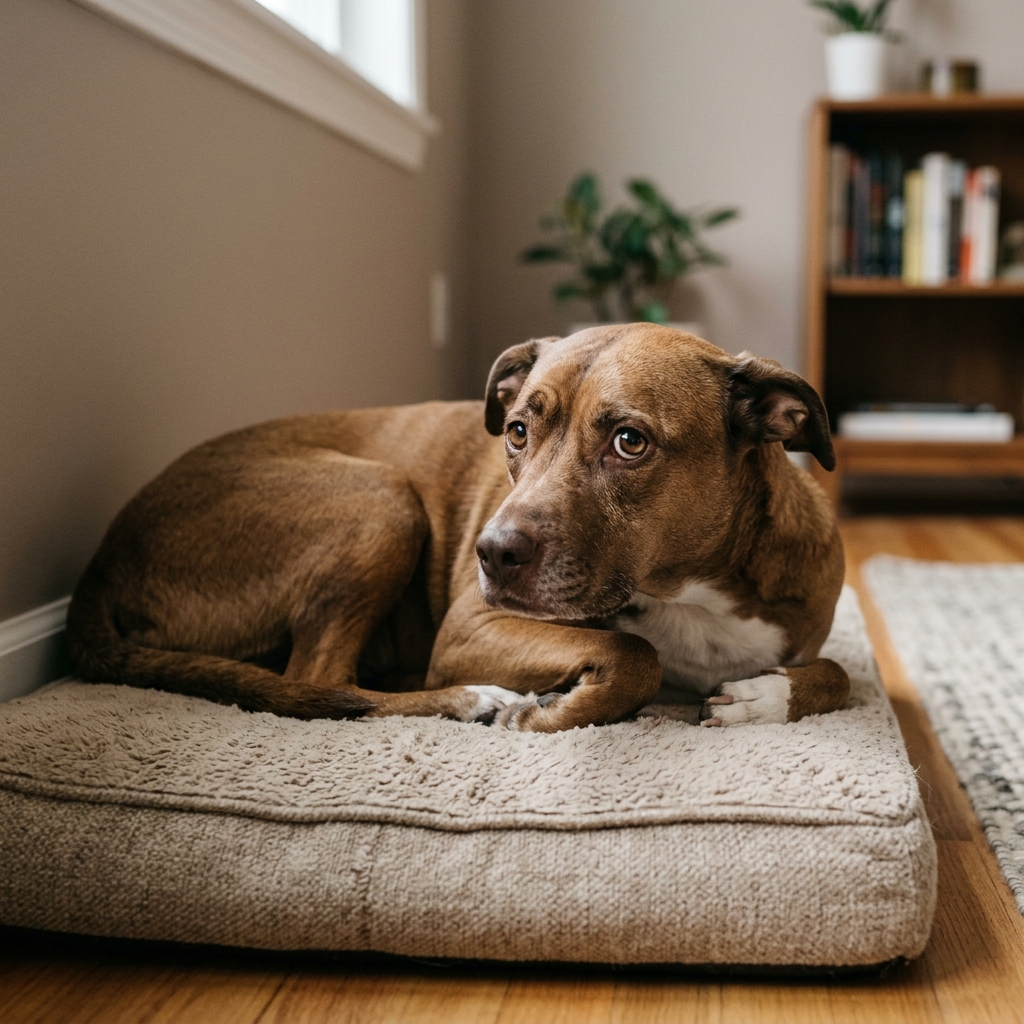
Anxiety in dogs rarely looks dramatic. It's usually quiet, easy to miss, and often mistaken for "just their personality."
When people picture an anxious dog, they usually picture panic — frantic barking, a dog cowering in a corner during a thunderstorm. Real anxiety is often much quieter than that. It shows up as a dog who won't quite settle, who licks their lips for no obvious reason, who's labelled "just a bit sensitive" for years before anyone connects the dots.
Recognising it early matters, because unaddressed anxiety tends to compound — a dog who's mildly anxious for years without support often becomes a dog with more serious behavioural issues later. This guide covers the subtle signs first, since those are the ones most commonly missed, and the obvious ones after.
Worth knowing: Anxiety isn't a character flaw and it isn't "bad training." It's a genuine emotional and physiological response, and in most cases, it's manageable with the right support.
The Subtle Signs — Body Language
These are the ones owners most often miss, because they're easy to mistake for a dog simply being tired, shy, or "just like that."
Whale Eye
This is when the whites of a dog's eyes become visible at the corners, often while their head stays still or turned slightly away from whatever's bothering them. It's one of the clearest early stress signals in dog body language, and it's frequently missed because it's subtle and easy to mistake for a normal sideways glance.
Pinned-Back Ears & a Tucked Tail
Ears held flat against the head and a tail held low or tucked between the legs are classic discomfort signals across nearly all breeds, though they show differently depending on ear and tail shape. A consistently low tail carriage, not just an occasional tuck during something startling, is worth paying attention to.
Repeated Lip Licking & Yawning
A single lip lick or yawn means very little on its own. Repeated lip licking with no food nearby, or yawning that happens outside of tiredness — especially paired with other signs on this list — is a recognised calming signal dogs use when they're uncomfortable.
A Lowered, Stiff Body Posture
An anxious dog often makes themselves smaller — crouching slightly, moving with a stiff, low gait, or leaning away from people or objects rather than approaching with loose, relaxed movement. This is different from simple calmness; the stiffness is the key detail.
The More Obvious Signs — Behaviour
These tend to get noticed faster, mainly because they're disruptive — but they're still often dismissed as "just energy" or "a phase."
Pacing or Restlessness
An inability to settle, repeatedly circling the same spot, or getting up and lying down over and over without an obvious trigger is a common physical expression of anxiety, particularly around specific times like before owners leave the house.
Destructive Behaviour When Alone
Chewed door frames, scratched-up exits, or destroyed furniture specifically while a dog is left alone, rather than as general puppy chewing, is one of the more recognisable signs of separation-related anxiety, especially if it's concentrated near doors and windows.
Excessive Barking, Whining, or Howling
Vocalising that's clearly distress-driven rather than alert-barking — particularly when alone, during specific triggers like fireworks, or in new environments — is a common anxiety signal, especially when it continues well after the trigger has passed.
Excessive Panting or Drooling Without Heat or Exercise
Heavy panting or drooling when a dog hasn't been physically active and the environment isn't hot is a physiological stress response, not just a habit. It's particularly common during car rides, vet visits, or thunderstorms.
Excessive Licking or Grooming of Themselves
Some dogs redirect anxiety inward — licking their paws, legs, or flank repeatedly, sometimes to the point of creating a bald or irritated patch of skin. This is worth distinguishing from an allergy or skin condition, since the underlying cause and treatment are different.
When anxiety appears suddenly: A dog who develops anxious behaviour abruptly, especially later in life, may be dealing with an underlying medical issue rather than purely behavioural anxiety. Pain, thyroid imbalances, and cognitive decline in senior dogs can all present as new anxiety-like symptoms. Sudden-onset anxiety, particularly in an older dog, is worth a vet visit before assuming it's purely behavioural.
What You Can Do at Home
None of this replaces professional guidance for moderate to severe anxiety, but these genuinely help as a starting point.
- Keep a predictable routine. Consistent feeding, walk, and sleep timing reduces a major source of background uncertainty for an anxious dog.
- Create a designated safe space. A crate, a covered bed, or a quiet corner your dog can retreat to without being followed or disturbed.
- Avoid reinforcing the fear unintentionally. Excessive comforting during a panic episode can sometimes reinforce the anxious response — calm, neutral presence tends to help more than dramatic reassurance.
- Consider calming aids for specific triggers. Pressure wraps, pheromone diffusers, or calming chews can help with situational anxiety like storms or car rides — discuss options with your vet first.
- Don't wait too long to get help. A certified trainer or veterinary behaviourist can make a meaningful difference, especially for separation anxiety, which rarely resolves fully without some structured intervention.
Frequently Asked Questions
The questions dog owners ask most about anxiety in their pets.
How is normal nervousness different from actual anxiety in a dog?
Occasional nervousness — a brief startle at a loud noise, mild caution around a new person — is a normal part of being a dog and resolves quickly once the trigger passes. Anxiety becomes a more genuine concern when the response is disproportionate to the actual trigger, happens repeatedly across unrelated situations, or doesn't ease once the immediate cause is gone. A dog who's anxious is often showing several signs together — body language changes plus behavioural ones — rather than a single isolated moment of nervousness. If the pattern is frequent and consistent rather than occasional, it's worth taking seriously rather than assuming it's just personality.
Can puppies have anxiety, or is this only something adult dogs experience?
Puppies absolutely can experience anxiety, and early socialisation during the first few months has a significant influence on how anxious or confident a dog becomes as an adult. A puppy who missed exposure to varied people, sounds, and environments during this critical period is more likely to develop anxiety-related behaviours later. That said, some mild nervousness is genuinely normal in young puppies as they learn about the world, and it often improves with gentle, positive exposure rather than requiring intervention. Persistent or severe fear responses in a puppy are worth addressing early, since habits formed now tend to carry into adulthood.
My dog only seems anxious when I leave the house. Is that separation anxiety?
It's a strong possibility, particularly if it's paired with signs like destructive behaviour near exits, excessive vocalising shortly after you leave, or pacing that starts as soon as you pick up your keys or bag. True separation anxiety is specifically tied to being apart from a particular person or people, rather than being alone in general — some dogs are completely fine alone in one room but distressed if a specific person leaves the house. A trainer or veterinary behaviourist can help confirm the pattern and build a structured desensitisation plan, since separation anxiety rarely improves on its own without some deliberate, gradual training.
Are some dog breeds more prone to anxiety than others?
There's some evidence that certain breeds and individual temperaments are more predisposed to anxiety, but it's far from the only factor — early life experience, socialisation, and individual personality often matter more than breed alone. Breeds bred for close human companionship or working closely alongside people are sometimes more prone to separation-related anxiety specifically, simply because they're wired to stay close to their person. That said, anxiety shows up across every breed and mixed-breed dog, so breed alone shouldn't be used to predict or dismiss anxiety in any individual dog.
Do I need medication for my dog's anxiety, or can it be managed with training alone?
It depends entirely on severity, and this is genuinely a case-by-case decision best made with a vet or veterinary behaviourist rather than guessed at independently. Mild to moderate anxiety often responds well to behavioural strategies alone — routine, gradual desensitisation, calming aids, and training. More severe anxiety, where a dog is in significant distress or behavioural approaches alone aren't producing meaningful improvement, may genuinely benefit from anti-anxiety medication prescribed by a vet, often used alongside training rather than as a replacement for it. There's no shame in this route if a vet recommends it — it's a legitimate medical tool, not a last resort for failure.
Gully Tails Editorial
The Gully Tails team brings you expert-reviewed guides and practical advice for pet parents in India.