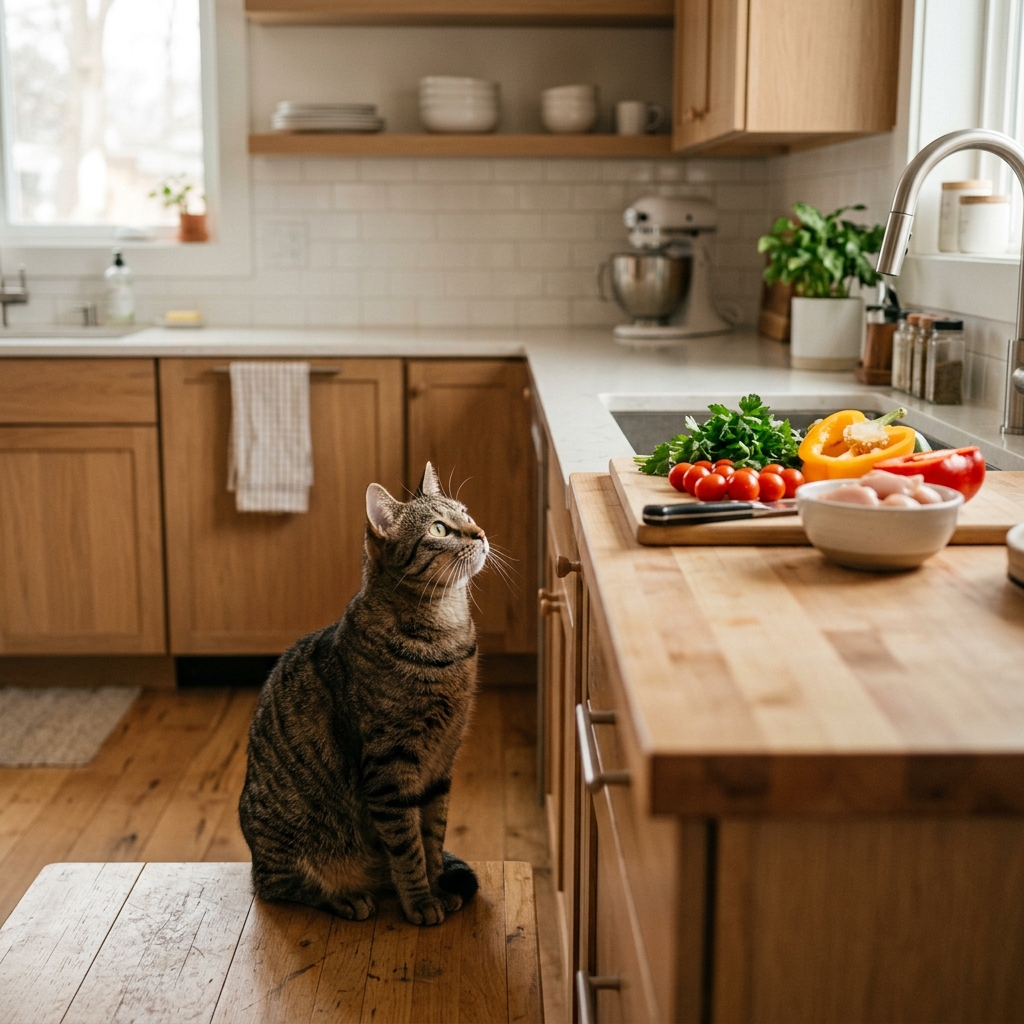
Your cat eyeing your plate doesn't mean your plate is safe for them. Here's exactly what's fine to share, what needs caution, and what should never reach their bowl.
Your cat parks themselves by your plate the moment something interesting-smelling appears. It's easy to assume that because cats are natural carnivores, meat-based human food must be fine for them. It often isn't.
Cats are obligate carnivores with a stricter, more specialised digestive system than dogs — which means some foods that are perfectly fine for a dog are genuinely dangerous for a cat, and vice versa. This guide sorts the rumours from the real risks, specifically for cats.
Worth knowing: Cats lack the taste receptor for sweetness, so they're rarely drawn to chocolate or sugary foods on their own — but if they do ingest them (often hidden in baked goods), the danger is just as real as it is for dogs.
Quick note: "Safe in moderation" means a small amount occasionally — not a daily habit. A cat's small body size means even modest amounts of a toxic food can have an outsized effect. When in doubt, skip it and call your vet.
Safe vs Toxic — Quick Scan
Save this. It's the fastest way to check before you share.
Toxic: Onions, garlic, leeks & chives; Chocolate & cocoa; Grapes & raisins; Raw dough & alcohol. Caution: Raw fish (regularly fed); Cow's milk & dairy; Tuna (human-grade, canned); Raw eggs. Safe: Cooked plain chicken or fish (no bones, no seasoning); Plain cooked egg; Small bits of carrot or pumpkin (cooked); Plain cooked rice (small amount); Cat-safe commercial treats; Catnip (fresh or dried).
Never Feed These — No Exceptions
These aren't "in moderation" foods for a cat. Even small amounts can cause serious harm, and a cat's small body size makes the margin for error even thinner than it is for dogs.
Onions, Garlic, Leeks & Chives
Every form counts — raw, cooked, powdered, or in stock and gravies. Compounds in the allium family damage a cat's red blood cells, and cats are actually more sensitive to this toxicity than dogs are, gram for gram of body weight.
Watch for pale gums, weakness, rapid breathing, or red-tinged urine over the following 1–4 days. A few licks of gravy with onion in it is enough to matter.
Chocolate & Cocoa
Chocolate contains theobromine and caffeine, both of which cats metabolise very slowly. Cats are less likely to seek out chocolate on their own since they can't taste sweetness, but accidental exposure — a cat sniffing or licking a dropped piece, or getting into baked goods — carries the same risk as it does for dogs.
Watch for vomiting, restlessness, a racing heart, tremors, and in serious cases, seizures.
Grapes & Raisins
Far less commonly reported in cats than dogs, but vets still treat any ingestion as a precaution since the toxic mechanism isn't fully understood and cats have shown similar kidney injury in rare documented cases. There's no reliable way to predict which cat might react badly.
Watch for vomiting, lethargy, and reduced urination in the 24–48 hours after exposure. This includes raisins in baked goods or trail mix left within reach.
Raw Dough & Alcohol
Unbaked dough containing yeast continues to rise in the warmth of a cat's stomach, producing alcohol and gas, and can also cause a dangerous bloating of the stomach. Alcohol itself — even a small lapped-up spill — affects a cat's tiny body far more severely than it would a human's.
Watch for disorientation, vomiting, a swollen abdomen, laboured breathing, or a drop in body temperature.
Handle With Caution
These won't usually cause an emergency, but they come with cat-specific conditions attached — easy to get wrong if you're not paying attention.
Raw Fish (Fed Regularly)
An occasional small amount of raw fish is unlikely to cause harm, but feeding raw fish regularly is a genuine problem. Certain raw fish contain an enzyme called thiaminase, which breaks down thiamine (vitamin B1) — a nutrient cats depend on heavily. Over time, this can lead to a serious thiamine deficiency affecting the nervous system. Cooking the fish destroys the enzyme and removes the risk.
Cow's Milk & Dairy
The "cats love milk" image is mostly myth — most adult cats are lactose intolerant, having lost the enzyme needed to digest it efficiently after kittenhood. A saucer of milk often leads to diarrhoea, gas, or vomiting within hours, not a happy cat.
A small lick of plain yoghurt is usually better tolerated than milk or cheese, but it's not a necessary addition to any cat's diet.
Tuna (Human-Grade, Canned)
An occasional small amount is fine and cats love it — but human-grade tuna isn't nutritionally balanced for cats and can be high in mercury and sodium with regular feeding. Some cats also become so fixated on tuna that they refuse balanced cat food in favour of it, which causes nutritional deficiencies over time.
Treat it as an occasional treat, not a meal replacement or daily topper.
Raw Eggs
The concern is bacterial contamination — Salmonella and E. coli — plus a protein in raw egg white that can interfere with biotin absorption if fed regularly over time. Cooked, plain egg is a fine occasional protein addition and avoids both issues entirely.
Genuinely Safe to Share
These can be a fine occasional addition for most cats — though remember, cats don't actually need anything beyond a complete cat food to thrive.
Plain Cooked Chicken & Fish
A protein-rich treat cats genuinely benefit from, given they're obligate carnivores. Keep it unseasoned — no salt, garlic, onion, or oil — and check fish thoroughly for bones, which are a bigger choking risk for a cat's smaller airway than for a dog.
Plain Cooked Egg
A small amount of fully cooked, unseasoned egg is a good source of easily digestible protein. Scrambled with no oil, salt, or butter is the simplest way to offer it.
Small Bits of Cooked Carrot or Pumpkin
Cats don't need vegetables the way dogs benefit from them, since they're obligate carnivores — but a small amount of plain cooked pumpkin is sometimes recommended by vets to help with mild digestive upset, thanks to its fibre content. Keep portions tiny; this is a supplement, not a meal component.
Plain Cooked Rice (Small Amount)
Not a nutritional necessity for a cat, but a small spoonful mixed into food is sometimes used to help bulk out a meal during mild digestive upset, on a vet's advice. It shouldn't make up a significant part of any cat's regular diet.
Cat-Safe Commercial Treats
Treats formulated specifically for cats are designed around their nutritional needs and are generally the safest, most reliable way to reward your cat without guessing at human-food risk. Look for treats that list real animal protein first and avoid excessive fillers.
Catnip
Not a food in the traditional sense, but worth including — fresh or dried catnip is safe for the vast majority of cats and triggers a harmless, often entertaining response. Not all cats react to it; this is a genetic trait, and kittens under about six months typically don't respond yet.
If Your Cat Eats Something Toxic
- Call your vet immediately — even if your cat seems fine. Cats often mask symptoms well, and many toxins take hours to show effects.
- Don't induce vomiting unless a vet specifically tells you to. For some substances, vomiting makes things worse.
- Note what and how much was eaten, and roughly when — this changes how a vet treats the case.
- Keep the packaging if it's a packaged food, so the vet can check the exact ingredients.
Do this today: Save your nearest vet's number in your phone right now. Search 'vet near me' on GullyTails and bookmark a 24/7 emergency clinic before you ever need one in a hurry.
Frequently Asked Questions
The questions cat parents ask most about feeding human food.
Is tuna actually bad for cats? Mine loves it.
Tuna itself isn't toxic, and most cats genuinely love it — the concern is about regularity, not the occasional spoonful. Human-grade tuna lacks the balanced nutrients a cat needs and can be relatively high in sodium and mercury if fed often. The bigger practical issue many owners run into is that cats can become so fixated on tuna's strong smell and taste that they start refusing their regular, nutritionally complete food. As an occasional treat — a small amount once a week or so — it's generally fine. As a daily habit or meal replacement, it isn't a good idea.
Why can't cats have milk if they're often shown drinking it?
It's one of the most persistent myths about cats. Kittens can digest milk because they produce an enzyme called lactase to break down lactose while nursing — but most cats lose much of this enzyme as they mature past weaning. Without it, lactose passes through the gut undigested and ferments, which is what causes the diarrhoea and gas many owners notice after giving milk. Some adult cats retain enough lactase to tolerate a small amount without issue, but there's no way to know in advance which cats will react badly, so it's safest to treat milk as something to avoid rather than a typical treat.
My cat got into a small piece of garlic naan. How worried should I be?
It depends on the amount, but it's worth taking seriously rather than dismissing. Garlic belongs to the same allium family as onions, and cats are actually more sensitive to its toxic effects on red blood cells than dogs are, relative to body size. A small bite of garlic naan is unlikely to be a large dose, but symptoms from allium toxicity can take a day or more to appear — pale gums, lethargy, and reduced appetite are early signs to watch for. If you know roughly how much was eaten, calling your vet with that detail lets them advise you accurately rather than guessing.
Is it okay to feed my cat raw fish or raw meat as part of a "natural" diet?
This is genuinely more nuanced than a simple yes or no. Raw feeding has real risks that are easy to underestimate: bacterial contamination (Salmonella, E. coli) that affects both the cat and anyone handling their food, and with raw fish specifically, an enzyme called thiaminase that destroys vitamin B1 and can cause serious neurological problems if fed regularly. Properly formulated raw diets exist and some vets support them when done correctly, but "raw fish or meat from the kitchen" isn't the same as a nutritionally complete raw diet. If you're interested in raw feeding, it's worth discussing a properly balanced commercial raw diet with your vet rather than improvising with raw cuts meant for human cooking.
My cat has kidney issues. Are there foods on the "safe" list I should still avoid?
Yes — "safe" describes general toxicity risk for a typical healthy cat, not how every cat's individual health condition will respond. Cats with kidney disease often need to manage phosphorus and protein intake carefully, which can make even "safe" high-protein treats like chicken or tuna something to limit rather than offer freely. Cats with diabetes, pancreatitis history, or food allergies have their own specific considerations too. If your cat has a diagnosed condition, it's worth checking with your vet before adding any human food — including items from the safe list — since their individual treatment plan takes priority over general guidance like this.
Gully Tails Editorial
The Gully Tails team brings you expert-reviewed guides and practical advice for pet parents in India.