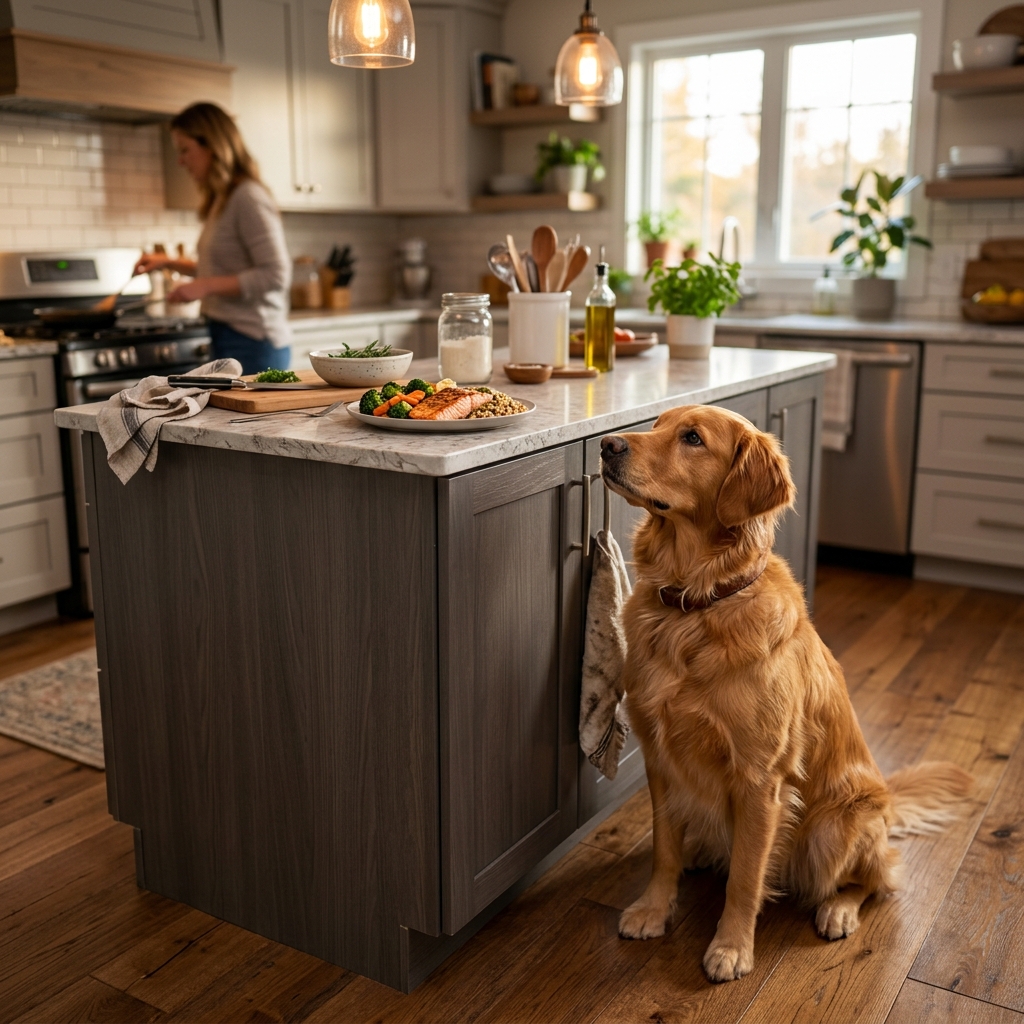
That begging face at the dinner table is hard to say no to. Here's exactly what's fine to share, what needs caution, and what should never reach your dog's bowl.
Those eyes by the dining table aren't subtle. And sharing a bite feels harmless — most of the time, it is. But a surprising number of everyday kitchen staples that are completely fine for us can put a dog in an emergency room within hours.
The tricky part is that "natural" and "safe" aren't the same thing. Grapes are natural. Onions are natural. Both can be dangerous for a dog in the wrong amount. This guide sorts the rumours from the real risks — so the next time a paw taps your knee at dinner, you'll know exactly what to do.
Quick note: Every dog's tolerance varies with size, breed, age, and health. "Safe in moderation" means a small amount occasionally — not a daily habit. When in doubt, skip it and call your vet.
Safe vs Toxic — Quick Scan
Save this. It's the fastest way to check before you share.
Toxic: Grapes & raisins; Onions, garlic, leeks & chives; Chocolate & cocoa; Xylitol (sugar-free gum, some peanut butter); Macadamia nuts; Alcohol; Cooked bones (chicken, fish, any). Caution: Avocado flesh; Cow's milk & dairy; Salty or fried snacks; Raw eggs & raw meat. Safe: Cooked plain chicken or fish (no bones, no seasoning); Carrots & green beans; Plain cooked rice or oats; Apple slices (no seeds, no core); Plain natural peanut butter (xylitol-free).
Never Feed These — No Exceptions
These aren't "in moderation" foods. Even small amounts can cause serious harm, and some are toxic in quantities far smaller than people expect.
Grapes & Raisins
One of the most unpredictable toxins in dogs. The exact cause isn't fully understood, but even a small number of grapes or raisins has caused acute kidney failure in some dogs — while others tolerate the same amount with no issue. Because there's no way to predict which dog will react, vets treat any ingestion as an emergency.
Watch for vomiting, lethargy, and reduced urination in the following 24–48 hours. This includes raisins baked into cakes, cereal, or trail mix.
Onions, Garlic, Leeks & Chives
Every form counts — raw, cooked, powdered, or dehydrated in stock cubes and gravies. Compounds in the allium family damage a dog's red blood cells, leading to a type of anaemia that can take days to show symptoms.
Watch for pale gums, weakness, rapid breathing, or red-tinged urine. A dish cooked "with a bit of onion for flavour" is still a real risk — the compound survives cooking.
Chocolate & Cocoa
Chocolate contains theobromine and caffeine, which dogs metabolise far slower than humans. Darker chocolate and baking cocoa are the most dangerous — a small amount of dark chocolate can affect a small dog far more severely than the same weight of milk chocolate would.
Symptoms include vomiting, restlessness, a racing heart, tremors, and in serious cases, seizures. This covers cakes, brownies, hot chocolate mix, and cocoa powder — not just chocolate bars.
Xylitol
This sugar substitute is in sugar-free gum, some peanut butters, baked goods, and breath mints — and it's one of the fastest-acting toxins on this list. Xylitol triggers a rapid insulin surge in dogs, causing blood sugar to crash within 10–60 minutes, and can also cause liver failure.
Watch for weakness, wobbliness, vomiting, or collapse — these can appear shockingly fast. Always check peanut butter labels for "xylitol" before sharing a spoonful.
Macadamia Nuts
The exact toxin isn't fully identified, but macadamia nuts reliably cause weakness, particularly in the hind legs, along with tremors, vomiting, and a mild fever — usually within 12 hours of ingestion. Most dogs recover within 1–2 days with care, but it still warrants a vet call.
This includes macadamia nuts hidden in cookies, trail mixes, or chocolate-covered snacks.
Alcohol
Dogs are far more sensitive to alcohol than humans, and it doesn't take much. This includes drinks, but also unbaked dough containing yeast, which produces alcohol as it rises inside a warm stomach.
Watch for disorientation, vomiting, laboured breathing, and in severe cases, a dangerous drop in body temperature or seizures.
Cooked Bones
Cooking changes a bone's structure, making it brittle. Cooked chicken, fish, or mutton bones can splinter into sharp fragments that cause choking, or tear the oesophagus, stomach, or intestinal lining on the way through.
Watch for gagging, drooling, blood in stool, or a refusal to eat after a bone has been swallowed — these need same-day vet attention.
Handle With Caution
These won't usually cause an emergency, but they come with real conditions attached — easy to get wrong if you're not paying attention.
Avocado
The flesh in small amounts is usually tolerated, but avocados are high in fat, which can trigger pancreatitis in sensitive dogs. The bigger danger is the pit and skin — both contain persin, which is more concentrated there, and the pit itself is a serious choking and intestinal blockage risk.
Cow's Milk & Dairy
Most adult dogs are lactose intolerant to some degree — they lose the enzyme needed to digest lactose efficiently after puppyhood. A small lick of yoghurt rarely causes harm, but a bowl of milk often leads to loose stools, gas, or vomiting a few hours later.
Plain, unsweetened yoghurt in small amounts is generally better tolerated than milk or cheese.
Salty & Fried Snacks
Chips, fries, papad, or salted nuts in large quantities can lead to excessive thirst, urination, and in extreme cases sodium ion poisoning. Fried, fatty foods are a common trigger for pancreatitis, particularly in smaller breeds and dogs already prone to weight gain.
Raw Eggs & Raw Meat
The bigger concern isn't the food itself but bacterial contamination — Salmonella and E. coli risk exists for both the dog and anyone handling their bowl afterward. Raw egg whites also contain a protein that can interfere with biotin absorption over time if fed regularly.
Cooked, plain eggs are a fine occasional protein boost.
Genuinely Safe to Share
These can be a healthy addition to a dog's diet — some are even better than the average treat from a packet.
Plain Cooked Chicken & Fish
An excellent lean protein source, and one many vets recommend as a bland-diet option during stomach upset. Keep it unseasoned — no salt, garlic, onion, or oil — and always check fish for bones first.
Carrots & Green Beans
Low-calorie, high-fibre, and satisfying to chew — raw or steamed both work. Many dogs treat raw carrot like a treat, and it's a useful swap for calorie-dense store-bought biscuits if your dog is managing their weight.
Plain Cooked Rice & Oats
Gentle on digestion and commonly recommended alongside boiled chicken for dogs recovering from an upset stomach. Plain oats also offer fibre and can be a good option for dogs with grain sensitivities to other cereals — though check with your vet if your dog has a known grain allergy.
Apple Slices & Watermelon
Both are hydrating, low-calorie snacks dogs tend to enjoy in hot weather. Always remove apple seeds and the core — they contain trace amounts of cyanogenic compounds — and remove watermelon seeds and rind, which can cause an upset stomach or blockage.
Plain Peanut Butter (Xylitol-Free)
A favourite for stuffing puzzle toys — just double-check the label for xylitol every single time, since brands reformulate without much warning. Natural, unsweetened, unsalted peanut butter is the safest version to keep in the house.
Pumpkin (Plain, Cooked or Canned)
Widely used by vets to help firm up loose stools or ease mild constipation, thanks to its fibre content. Make sure it's plain pumpkin puree — not spiced pumpkin pie filling, which often contains sugar, nutmeg, or other additives unsafe for dogs.
If Your Dog Eats Something Toxic
- Call your vet immediately — even if your dog seems fine. Many toxins take hours to show symptoms, and early treatment is far more effective than waiting.
- Don't induce vomiting unless a vet specifically tells you to. For some substances, vomiting makes things worse.
- Note what and how much was eaten, and roughly when — this changes how a vet treats the case.
- Keep the packaging if it's a packaged food, so the vet can check the exact ingredients.
Do this today: Save your nearest vet's number in your phone right now. Search 'vet near me' on GullyTails and bookmark a 24/7 emergency clinic before you ever need one in a hurry.
Frequently Asked Questions
The questions dog parents ask most about feeding human food.
My dog ate a small piece of chocolate and seems totally fine. Do I still need to worry?
It depends on the type and amount of chocolate relative to your dog's size. Dark chocolate and baking cocoa are far more concentrated in theobromine than milk chocolate, so a small piece of dark chocolate can matter more than a similar amount of milk chocolate. Symptoms can take several hours to appear — vomiting, restlessness, a fast heart rate, and tremors are the main things to watch for over the next 24 hours. If you know the type of chocolate and roughly how much was eaten, calling your vet with that information lets them tell you quickly whether it's a genuine concern or just something to monitor. When unsure, it's always better to call.
Is it true that dogs can't have any fruit at all?
No — that's a common myth. Many fruits are genuinely fine and even healthy for dogs in moderation: apple slices (no seeds or core), watermelon (no seeds or rind), blueberries, bananas, and pears are all generally safe. The fruits to actually avoid are grapes and raisins, which are toxic, and anything with a pit containing trace cyanide compounds, like cherries or unripe peaches — the pit is the issue, not the fruit's flesh. The safest approach is introducing any new fruit in a small amount first and watching for an upset stomach before making it a regular treat.
How much onion or garlic is actually dangerous for a dog?
There's no universally "safe" amount, which is why vets recommend avoiding it entirely rather than trying to calculate a safe dose. The toxic effect builds up with repeated small exposures too — so a dog who occasionally gets table scraps with a bit of onion gravy over weeks can develop the same anaemia as one who ate a large amount at once. Risk also scales with the dog's size: a small dog is affected by a much smaller amount than a large dog. If a dish was cooked with onion, garlic, leek, or chive — even just for flavour — it's safest to keep it away from your dog completely, rather than assuming "a little flavoring" doesn't count.
Can I give my dog peanut butter every day as a treat?
Occasionally, yes — daily, it depends on the amount and your dog's overall diet. Peanut butter is calorie-dense and high in fat, so a daily habit can contribute to weight gain or, in sensitive dogs, pancreatitis over time. The non-negotiable rule is always checking the label for xylitol before buying or using a new jar, since manufacturers can reformulate products without much warning, and xylitol poisoning can be fatal within an hour. If you want to use it daily for a puzzle toy, a thin smear rather than a full spoonful keeps the calorie count reasonable.
My dog has a sensitive stomach. Are there any "safe" foods on this list I should still avoid?
Yes — "safe" describes general toxicity risk, not how every individual dog's digestion will react. Dogs with sensitive stomachs, food allergies, pancreatitis history, or specific health conditions (like kidney disease or diabetes) may need to avoid foods that are perfectly fine for most dogs. Dairy, fatty cuts of meat, and high-fibre vegetables are common triggers even when they're not toxic. If your dog has a known sensitivity or a chronic condition, it's worth checking with your vet before introducing any new human food — including the ones on the "safe" list — rather than assuming general guidance applies to your dog specifically.
Gully Tails Editorial
The Gully Tails team brings you expert-reviewed guides and practical advice for pet parents in India.